RAISING THE BAR
The King's Legal Clinic
Providing legal support to those who need it and giving our law students hands-on experience, long before they graduate.
Almost everyone needs legal support at some point in their lives – whether it's disputes over house repairs, separating from a partner or writing a will.
And yet, only half will seek professional help. Some are unaware of what’s available, lack confidence that it will help, or simply cannot afford to pay a lawyer. Making some legal cases as much a battle of finances as a battle of the law. Significant cuts over the years mean many people across the UK who are eligible to receive support cannot access it. 12.45m people live in legal aid deserts for housing in England and Wales.
To live out our University’s 200-year-old commitment to serving society, King’s College London is making legal advice more accessible to those who would otherwise struggle to access it.
FROM ENQUIRY
TO ADVICE
King’s law students provide free advice to members of the public, working under the supervision of qualified lawyers as part of the King’s Legal Clinic.
The first step is meeting with the client to understand their challenge. The clinic sees a huge variety of cases – from family and housing, to immigration and asylum, to employment. Students research each client’s issues to get a clear view of all relevant legal considerations.
With the support of practising lawyers, students then write a letter of legal advice that helps clients understand their options and next steps. The Clinic also signposts clients to other services that could help.
The financial burden of the case is reduced for the client, without compromising on the quality of the advice. The advice helps the client understand practical next steps, including how to resolve the issues informally if appropriate, whether they need a qualified lawyer, if they are eligible for legal aid and what other support is available.
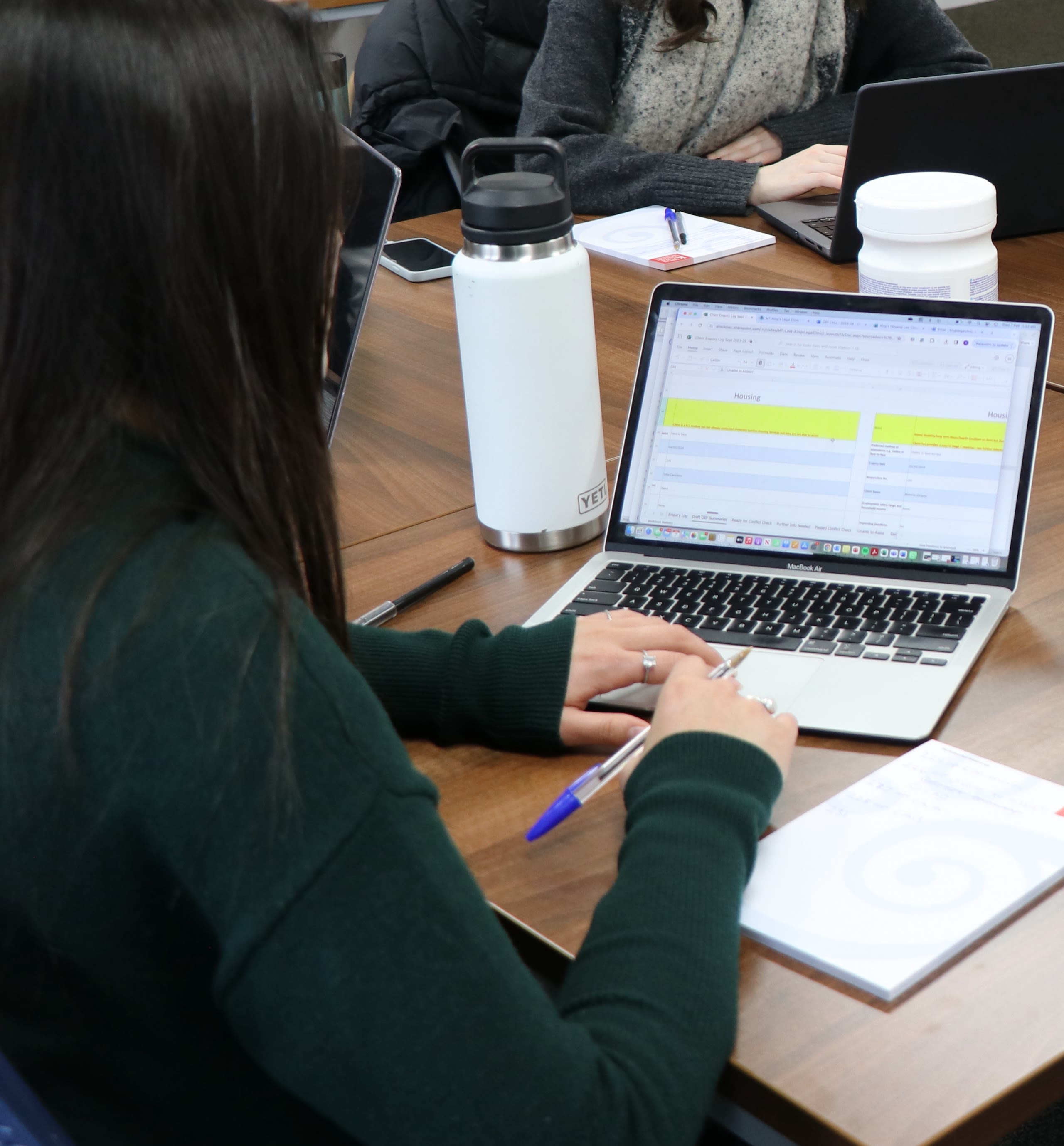


Demand for the Clinic’s services has grown significantly, with over 800 enquiries received each academic year.
More than 300 students are involved each year, either through academic modules or extracurricular volunteering.
Immigration Clinic client (Jan 2025)
‘It was helpful because I got to speak with a professional. Until now, I had been researching and dealing with it on my own. This advice will make a difference.’
Windrush Justice Clinic client (Feb 2025)
‘Without the legal assistance I received from the King’s students and my solicitor, it would have been impossible to navigate the intricate requirements and continuously shifting criteria. It was their support and expertise that finally made my voice heard, and my compensation was uplifted from £54,000 to £147,000.’
COMMUNITY
SPIRIT
Health and homelessness
London is facing a growing homelessness crisis, with rough sleeping levels at a record high.
A 2025 report from the King’s Legal Clinic showed that the lack of housing services is driving people experiencing homelessness to attend A&E instead, in search of help with filling out complex housing applications. This puts pressure on NHS services while delaying people from getting into secure, safe housing.
In response, King’s launched a new advice service where law students volunteer to work inside King’s College Hospital alongside their Homeless Health Team. In 2026, students have helped 80 patients navigate homelessness applications and legal processes, giving them a much better chance of gaining access to a stable home environment more quickly.
Reuniting families
Each year, thousands of refugees in the UK attempt to reunite with family following separation due to conflict or displacement – often after many years apart.
A 2026 Legal Clinic report shed fresh light on the challenges displaced children face navigating the legal reunification processes. There is a heavy reliance on DNA testing, which adds financial and logistical burdens. The report found flaws in decision-making, raising concerns around fairness and accuracy. The impact was significant, with children remaining stranded in conflict zones facing life-threatening risks, while families in the UK endured financial and emotional hardship, affecting integration.
To help, King’s is pairing law students with biomedical science students, combining evidence gathering and legal submissions with free DNA testing, provided by DNA@King’s, to help families find each other and reconnect.
Launched in 2025, the clinic has already supported four refugee families, including vulnerable children who were displaced from their homes and forced into hiding in Asia and Africa.
Human rights and the environment
Recognising the need for legal activism in the face of the climate and nature emergency, King’s hosts a special clinic dedicated to human rights and the environment. The clinic’s ‘Rights of Nature’ programme is creating a legal framework that champions nature being protected for its own sake, rather than defining its value by its usefulness to humans. This approach is helping to build laws that protect rivers, forests and other natural habitats.
For example, law students supported a landmark complaint in Serbia against threats to flora, fauna and wild habitats from a British-funded mine. A King’s geography researcher and University of Belgrade scientist embarked on a mission into a remote area of the country to collect icy river samples for analysis.
The case was presented in Strasbourg by a King’s pro bono counsel and, if successful, could set a legal precedent for the protection of nature, helping these principles become embedded within international law.
Niamh Cavoski Murphy, a student who worked on the case, said:
‘I not only gained practical experience but also came to better understand the real dangers and effects of illicit mining practices and state inaction. Being of part-Serbian heritage, it has been a privilege to work on a project which will hopefully have tangible consequences for improving Serbia’s environmental record and set a precedent for stronger environmental protection in the future.’
The Windrush Justice Clinic
In 2018, the UK government accepted that it had wrongly detained, deported and denied legal rights to the Windrush generation and other Commonwealth citizens and their children in what is now known as the ‘Windrush Scandal’.
The Clinic’s partnership with Southwark Law Centre delivered major wins for Windrush survivors. Students worked on cases which have secured over £700,000 in compensation for clients to date. The Clinic’s research has influenced systemic reform and been cited in Parliamentary debates and strategic legal challenges.
Shaessa Naidoo, a law student and Windrush Justice Clinic caseworker, shared how working at the clinic impacted her:
‘Systemic racism, such as the Windrush Scandal, makes the people impacted feel inherently inferior, when they are not. Seeing the power of having the means to resist unfair systems has motivated me to be involved in work that empowers individuals to rise above discrimination. I am so grateful for my time at the Windrush Justice Clinic, which has not only been full of support for me, but has also consistently centred clients’ needs.’ (Full article can be found here.)
THE SKILLS
TO SUCCEED
As well as directly helping some of the most vulnerable members of the public, the King’s Legal Clinic gives law students valuable experiences outside the classroom.
Traditional legal education focuses on learning from the past – studying legal history, doctrine and analysis. It teaches students to ‘think like a lawyer’ but can neglect crucial practical skills and emotional intelligence that only come from working with and understanding real people and real cases.
Students who volunteer in the King’s Legal Clinic get hands-on experiences with real clients and practising solicitors, building skills including legal research, legal writing, communication, efficiency and teamwork – skills that will give them a head start when they qualify as practising lawyers.
The Dickson Poon School of Law is recognised as one of the best law schools in the world, with a community of nearly 900 undergraduate students from around the globe.
Students can learn from the expertise of four in-house solicitors, as well as partnerships with law firms, barristers’ chambers and NGOs.
Luciano Sipiano, Student Administrator
‘Volunteering at King’s Legal Clinic has been the best way to step into the legal profession. It gave me the confidence to recognise how we can truly make a difference in people’s lives and how collaboration can have a positive, tangible impact. [...] It made the transition from studying law to applying it feel natural, easier and rewarding.’
Student Caseworker
‘Personally, working on this project was a constant reminder that our clients are not just a record of documents in a folder, but real people who are reliant on and deserving of the exceptional pro bono work offered at King’s Legal Clinic.’
Programmes like this are one way that King’s aims to give our graduates an edge in an increasingly competitive job market. Curricular and extracurricular opportunities like this offer wider experiences that build employability, confidence, creativity and entrepreneurship, making it easier for our graduates to enter the job market and to thrive once they’re there.
King’s Legal Clinic’s excellence in educating students, innovation and commitment to the community was recognised in two national pro bono awards in December 2025 and April 2026.
The Clinic is committed to growing its educational offering to support King’s students become better, more ethical lawyers with a commitment to social and environmental justice, wherever their careers take them.
The clinic welcomes opportunities to connect with alumni to provide pro bono case supervision and advance our growth and mission statement.
You can also find out about other ways to support King’s students through our Careers and Employability teams.
EDITORIAL TEAM
Teresa Richards
Ben Squire
Ellie Stone
WRITERS
Kelly Archer
Emily Barton
Hermione Cameron
Kate Denereaz
Kate Hazlehurst
Joely Langston
DESIGN
Principal design by Jonathan Vickers
Additional design by Harpoon Productions and Carly Yung
Photography by Nathan Clarke and Jim Winslet
All building images and design examples for Bush House South West Wing reflect architectural concepts and may be subject to change. Architectural concepts © Kohn Pederson Fox Associates and Plomp.
WITH SPECIAL THANKS TO
Paul Brooks
JH Norris
ALUMNI & EDITORIAL OFFICE
King’s College London
57 Waterloo Road,
London,
SE1 8WA
© King’s College London 2026
InTouch is published by the University’s Philanthropy & Alumni Engagement department. The opinions expressed in it are those of the writers and not necessarily those of the University.
If you have a story for our Autumn 2026 issue, email us at forever@kcl.ac.uk.
Terms & Conditions | Privacy Policy | Cookie Policy | Accessibility Statement
EDITORIAL TEAM
Teresa Richards
Ellie Stone
Ben Squire
WRITERS
Kelly Archer
Emily Barton
Hermione Cameron
Kate Denereaz
Kate Hazlehurst
Joely Langston
DESIGN
Principal design by Jonathan Vickers
Additional design by Harpoon Productions and Carly Yung
Photography by Nathan Clarke and Jim Winslet
All building images and design examples for Bush House South West Wing reflect architectural concepts and may be subject to change. Architectural concepts © Kohn Pederson Fox Associates and Plomp.
WITH SPECIAL THANKS TO
Paul Brooks
JH Norris
ALUMNI & EDITORIAL OFFICE
King’s College London
57 Waterloo Road,
London,
SE1 8WA
InTouch is published by the University’s Philanthropy & Alumni Engagement department. The opinions expressed in it are those of the writers and not necessarily those of the University.
If you have a story for our Autumn 2026 issue, email us at forever@kcl.ac.uk.
© King’s College London 2026
Terms & Conditions | Privacy Policy | Cookie Policy | Accessibility Statement
 Built with Shorthand